





A good beginner running schedule is all about consistency, not intensity. Most folks start out with just two or three run-walk sessions a week. The whole point is to build a habit you can actually stick with, one that prevents you from burning out or getting hurt right out of the gate.
Getting Started Without Getting Overwhelmed
Jumping into a new running routine can feel like a huge deal. A common mistake I see beginners make is thinking they need to pound the pavement every single day to make any progress. That "all or nothing" thinking is usually the biggest roadblock—it just leads to sore muscles, total exhaustion, and a quick exit from running.
The real key? Start slow and build momentum. Instead of aiming for daily miles, a smart running schedule for beginners puts a premium on recovery. Your body needs that downtime to adapt to the new demands of running. Rest days are when the magic happens—it's when your muscles repair and get stronger.
The Power of the Run-Walk Method
Forget any notion that you have to run nonstop from day one. The run-walk method is the foundation of almost every successful beginner plan, and for good reason: it flat-out works. By alternating short bursts of running with walking breaks, you can go farther with a lot less strain. It's the safest way to build up your cardio fitness and muscular endurance.
Here’s what a very first workout could look like:
- Warm-up: Start with 5 minutes of brisk walking.
- Main Set: Go through this 6 times: 1 minute of easy jogging, then 2 minutes of walking.
- Cool-down: Finish with 5 minutes of slow walking and some light stretching.
This simple formula is incredibly effective. It keeps the effort manageable, lowers your injury risk, and gives you the confidence boost you need to keep showing up.
How Often Should You Really Run?
When you’re first starting, your motivation is probably sky-high, but you have to channel that energy into patience. If you're completely new to running, coming back from an injury, or just have a crazy-busy schedule, starting with one or two running days a week is perfect.
Getting a couple of short runs in each week is a huge win and sets a solid foundation. You can find more expert advice on this at Runner's World to make sure you start safely.
The goal isn't to do as much as you can right away. It's to do just enough, consistently, so your body can adapt. This approach helps you sidestep the classic "too much, too soon" injuries that sideline so many new runners.
Your Week-by-Week Couch to 5K Plan
The Couch to 5K (C25K) program is legendary for a reason—it’s a simple, effective, and incredibly motivating plan that has turned countless beginners into runners. The magic is in its gradual progression. It builds your confidence right alongside your stamina, so you can forget the pressure of trying to run nonstop right out of the gate.
This isn't about going from zero to hero overnight. It’s a smart, structured plan designed to get you from the couch to a 5K (3.1 miles) finish line in about 8 to 9 weeks. You'll do three workouts a week, each lasting around 30 minutes. The whole system is built on a mix of walking and jogging intervals, where you slowly increase your running time and trim down your walking breaks. This approach is the secret to building endurance safely and without burning out. For a deep dive into the program's history and structure, Runner's World offers some great insights.
The schedule is designed around 3 workouts per week on non-consecutive days. A classic setup is Monday, Wednesday, and Friday, which gives your body crucial recovery time on Tuesday and Thursday.
This timeline shows you exactly how the journey unfolds, from your very first steps to that final triumphant run.
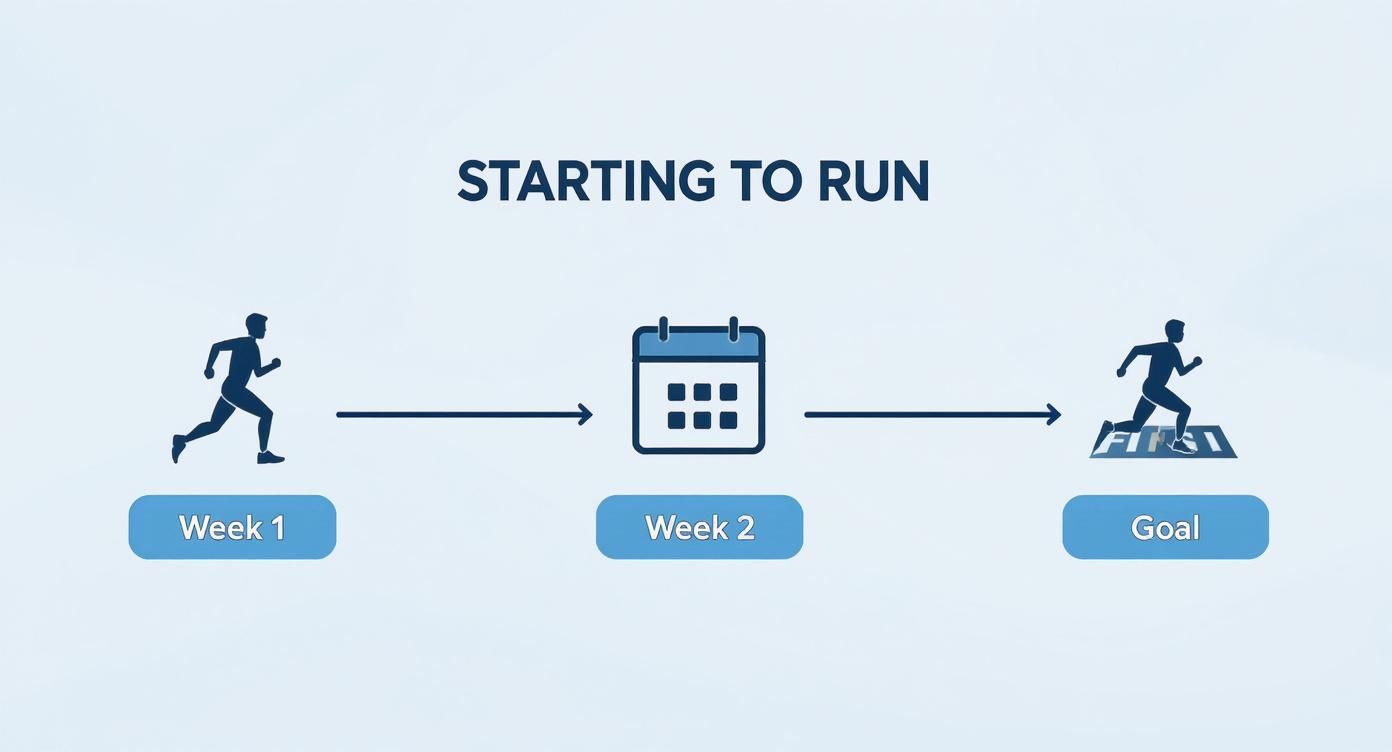
As you can see, it's a clear, manageable progression. You start with the basics in week one and steadily build toward your goal.
To give you a clearer picture of how it starts, here's a look at the run/walk intervals for the first four weeks.
Couch to 5K Quick Start Schedule
| Week | Workout Structure (Repeated 3x Per Week) |
|---|---|
| Week 1 | Brisk 5-min walk, then alternate 60 seconds jogging / 90 seconds walking for 20 mins. |
| Week 2 | Brisk 5-min walk, then alternate 90 seconds jogging / 2 minutes walking for 20 mins. |
| Week 3 | Brisk 5-min walk, then repeat twice: 90 secs jogging, 90 secs walking, 3 mins jogging, 3 mins walking. |
| Week 4 | Brisk 5-min walk, then: 3 mins jogging, 90 secs walking, 5 mins jogging, 2.5 mins walking, 3 mins jogging, 90 secs walking, 5 mins jogging. |
This table maps out the initial phase where you're just getting your body used to the new routine.
Weeks 1-3: The Foundation Phase
These first few weeks are all about building a habit and letting your body adapt. The focus is purely on time, not distance or speed. Don't even think about how far you're going—just stick to the prescribed intervals.
- Week 1: Start with a 5-minute brisk walk. Then, you'll alternate 60 seconds of jogging with 90 seconds of walking for a total of 20 minutes.
- Week 2: After your warm-up, switch to alternating 90 seconds of jogging with 2 minutes of walking for 20 minutes.
- Week 3: Following the 5-minute warm-up, you'll do two reps of this set: 90 seconds of jogging, 90 seconds of walking, 3 minutes of jogging, and 3 minutes of walking.
A personal tip here: It’s going to feel a bit awkward at first. Your breathing might feel all over the place, and your legs could feel like lead. That is 100% normal. Your only job is to keep moving and trust the process.
Weeks 4-6: Building Endurance
This is where things start to click. The running intervals get noticeably longer as the walking breaks shorten. Your mental game becomes just as important as your physical fitness here, because you're building real, tangible endurance.
- Week 4: After your warm-up, the workout is a 3-minute jog, 90-second walk, 5-minute jog, 2.5-minute walk, 3-minute jog, 90-second walk, and a final 5-minute jog.
- Week 5: This week introduces your first real nonstop runs. Workout 1: 5-min jog, 3-min walk, 5-min jog, 3-min walk, 5-min jog. Workout 2: 8-min jog, 5-min walk, 8-min jog. Workout 3 is the big one: a 20-minute nonstop jog.
- Week 6: You’re back to intervals for the first two workouts to keep building strength. Workout 1: 5-min jog, 3-min walk, 8-min jog, 3-min walk, 5-min jog. Workout 2: 10-min jog, 3-min walk, 10-min jog. Workout 3 challenges you with a 25-minute nonstop jog.
That first 20-minute run in Week 5 feels like a huge milestone. It might seem impossible on Monday, but the program is perfectly designed to get you there by Friday. When you do it, celebrate!
Key Takeaway: Listening to your body is more important than rigidly sticking to the schedule. If a particular week feels too challenging, it’s perfectly okay to repeat it. Progress isn't always linear; the goal is to finish the program healthy and strong.
Weeks 7-9: The Final Push
The last few weeks are about cementing all your hard work and getting you ready for that 5K distance. You've built the foundation, and now it's time to put it all together. The walk breaks are gone—you're officially a runner.
- Week 7: Three workouts, each with a brisk 5-minute walk followed by 25 minutes of jogging.
- Week 8: Three workouts, each with a brisk 5-minute walk followed by 28 minutes of jogging.
- Week 9: The home stretch! You'll do three workouts, each starting with a 5-minute warm-up walk and then 30 minutes of jogging.
By the time you finish Week 9, you’ll be running for 30 minutes straight. For most beginners, that’s more than enough time to cover the full 3.1 miles of a 5K. This plan is all about making the impossible feel totally achievable, one step at a time.
Building Your Foundational Running Habits
A smart running plan is so much more than just the runs themselves. The real secret to sticking with it and actually enjoying the process lies in the habits you build around your runs. Think of your warm-ups, cool-downs, and rest days as the unsung heroes of your training. They're the support system that keeps you healthy, strong, and genuinely excited for that next run on your schedule.

Honestly, one of the biggest mistakes I see new runners make is skipping this stuff. Diving straight into a run with cold muscles or immediately flopping onto the couch afterward might save you a few minutes, but that time adds up. Over time, those little omissions lead to stiffness, frustrating plateaus, and even injuries that can sideline you for weeks.
Priming Your Body with Dynamic Warm-Ups
Before you take that first running step, your goal is simple: get your body ready to move. This means ditching the old-school advice of holding a static stretch for 30 seconds. Instead, you want to embrace dynamic warm-ups. These are active movements that gently take your joints through their full range of motion, ramping up your heart rate, increasing blood flow, and literally warming up your muscles.
A good warm-up is like sending a memo to your body that it's time to work. It improves muscle elasticity and dramatically reduces your risk of pulling something. All it takes is 5-10 minutes to make a huge difference.
Here are a few of my go-to dynamic moves:
- Leg Swings: Find a wall or fence for balance. Swing one leg forward and back 10-15 times, then side-to-side. Repeat on the other leg to open up those tight hips.
- High Knees: Jog in place for about 30 seconds, focusing on bringing your knees up toward your chest with light, quick steps.
- Butt Kicks: Jogging in place or moving forward slowly, try to kick your own glutes with your heels. This is fantastic for waking up your hamstrings.
- Walking Lunges: Take a big step forward into a lunge, making sure your front knee stays over your ankle. Push off and immediately step into a lunge with the other leg. Aim for 10-12 total lunges.
These movements directly mimic running, so the right muscles are firing and ready to go from the moment you start your watch.
The Critical Role of the Cool-Down
When you finish your run, your job isn't quite over. A cool-down is your body's off-ramp, helping it transition from high gear back to a resting state. Stopping abruptly can cause blood to pool in your legs (which can make you feel dizzy), so a gradual slowdown is key.
Start with 5 minutes of slow walking. This gives your heart rate and breathing a chance to return to normal. Once you've settled down, now is the perfect time for some static stretching.
Your muscles are warm and pliable right after a run, making it the ideal time to work on flexibility. Holding each stretch for a good 20-30 seconds can help release tension and may even reduce some of that next-day muscle soreness.
A few essential static stretches for any runner:
- Hamstring Stretch: Sit down, extend one leg straight, and bend the other. Gently fold forward over the straight leg until you feel a comfortable stretch.
- Quad Stretch: Standing, hold onto something for balance. Grab an ankle and pull your heel toward your glute to feel a stretch along the front of your thigh.
- Calf Stretch: Stand facing a wall. Step one foot back, keeping your heel on the ground and the leg straight. Lean in until you feel the stretch in your calf.
Rest Days Are Training Days
It feels counterintuitive, but more running doesn't always equal more progress. In fact, it's often a fast track to burnout and injury. Rest days are a non-negotiable part of any running schedule for beginners. This is when the magic actually happens—it's when your body adapts and gets stronger.
Running creates tiny micro-tears in your muscle fibers. Rest is what gives your body the time it needs to repair those fibers, building them back even stronger. Without it, you're just breaking your body down over and over again. As a rule of thumb, schedule at least one full rest day after every two consecutive training days.
Soreness vs. Injury: Knowing the Difference
Learning to listen to your body is probably the most important skill you'll develop as a runner. It starts with understanding the difference between normal soreness and an actual injury.
- Normal Soreness (DOMS): This is that familiar, dull ache that shows up 24-48 hours after a tough workout. It’s usually widespread, feels tender, and affects muscles on both sides of your body. It should start to fade within a day or two.
- Injury Pain: This is different. It's often sharp, specific, and you can point to the exact spot. It might get worse as you run or linger long after. If you see swelling or can’t move normally, that’s a red flag. This kind of pain is your body yelling "Stop!"
Treat these foundational habits with the same respect you give your runs, and you won't just become a runner—you'll build a resilient, healthy running practice that can last for years.
Fueling Your Runs and Staying Injury-Free
What you do on your "off" days is just as important as the runs themselves. Seriously. A great running plan isn't just about logging miles—it's about building a body that can actually handle the work you're putting in. This really comes down to two things: smart nutrition and staying ahead of injuries.
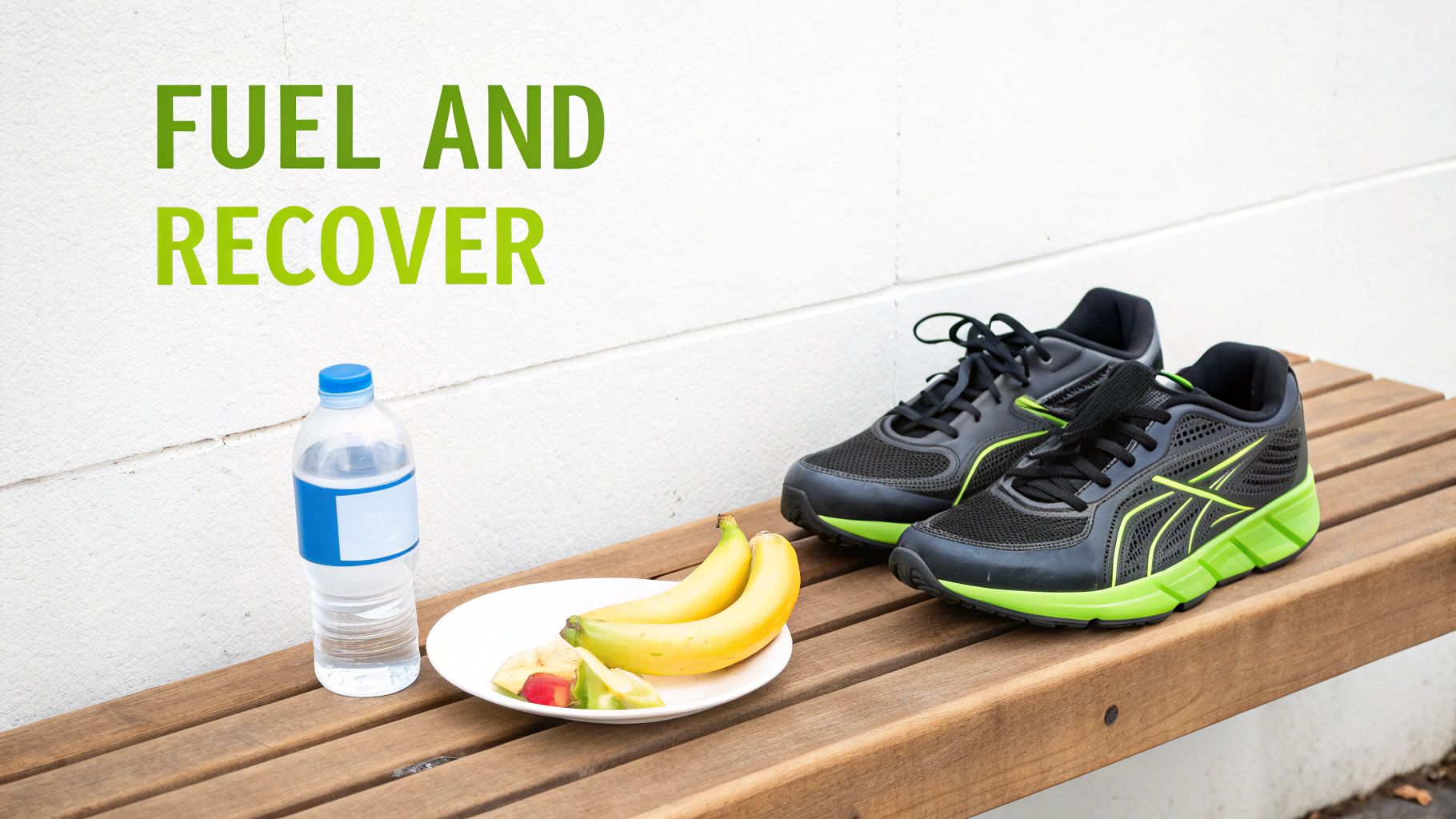
Without the right fuel, your runs will feel like a slog, and you'll drag through recovery. And if you ignore those little aches and pains? You risk turning a minor issue into a major setback that benches you completely.
Let's break down the simple, practical stuff that keeps you energized and healthy.
Simple Fuel for Better Runs
Good news: you don't need a complex, pro-athlete diet. The goal here is simple. Give your body easy-to-access energy before you head out the door, then give it the building blocks it needs to repair itself when you get back.
Pre-Run Fuel (30-60 minutes before):
Think light and carb-focused. Now is not the time for a big, heavy meal loaded with fiber or fat, which can cause cramping and digestive chaos mid-run.
- A small banana
- A piece of toast with a little jam
- A handful of pretzels
Post-Run Recovery (within 30-60 minutes after):
After your run, your mission is to restock your energy stores and repair those hard-working muscles. The magic combo is carbs and a bit of protein.
- A glass of chocolate milk (a classic for a reason!)
- Greek yogurt topped with some berries
- A simple protein shake
For the shorter runs you'll be doing as a beginner (under an hour), plain old water is all you need to stay hydrated. The key is to sip it throughout the day, not just chug it right before your run.
Avoiding Common Beginner Running Injuries
Nothing kills motivation faster than getting injured just as you're finding your groove. Most new-runner injuries come from a classic mistake: doing too much, too soon. The other culprit is often underlying muscle weakness that running quickly exposes.
This is exactly why following a structured plan works so well. It takes the guesswork out and prevents you from overdoing it. Research backs this up, too. One study on a six-week 'Start to Run' program saw a huge jump in participants meeting health guidelines. Before the program, only 43.9% met the standards; afterward, that number shot up to 74.8%. It's proof that a good schedule creates healthy, sustainable habits. You can read the full research about these findings if you want to dig into the data.
Recognizing the Warning Signs
Learning to tell the difference between "I worked hard" soreness and "uh-oh, that's not right" pain is a skill every runner needs. Keep an eye out for these common culprits:
- Shin Splints: That nagging, dull ache along the front of your lower leg. It’s a classic sign of overworked muscles and a big red flag that you might be ramping up your mileage too fast.
- Runner’s Knee: A frustrating pain that feels like it’s behind or around your kneecap. This is often tied to weak glutes and hips, which forces your knee to take on more strain than it should.
- Achilles Tendinitis: If you feel pain and stiffness at the back of your heel, especially in the morning, your Achilles tendon is probably angry. Tight calf muscles are usually to blame, so make friends with a good calf stretch.
Your best defense is to listen to your body. If you feel a sharp, stabbing, or persistent pain, take an extra rest day. Don't try to be a hero and run through it. If it doesn't go away, it’s time to see a physical therapist.
Your Most Important Piece of Gear
Finally, let’s talk about shoes. Your running shoes aren't a fashion statement; they are your most critical piece of equipment. They absorb shock, support your feet, and protect your joints. Running in old, dead sneakers is a one-way ticket to injury city.
A solid rule of thumb is to replace your shoes every 300-500 miles. If you're running three times a week, that works out to be about every six to nine months. Investing in a good pair from a specialty running store—where they can watch you run and fit you properly—is one of the smartest things you can do for your running journey.
How to Progress Beyond Your First 5K
Crossing that first 5K finish line is an incredible feeling. You followed a plan, put in the work, and proved to yourself that you are, in fact, a runner. So, what’s next?
The natural urge is to build on that success, but the key is to do it smartly. That same discipline that got you through your training is exactly what you need now to avoid hitting a plateau or—worse—getting injured.
It’s tempting to immediately start adding more miles, but your body needs time to adapt. Your muscles, tendons, and bones are still getting used to the new demands you're placing on them. A sudden jump in mileage is one of the fastest tickets to the sidelines. This is where a gradual, structured approach becomes your best friend.
The 10 Percent Rule: Your Golden Ticket to Smart Progression
To move forward safely, almost every running coach and physical therapist will point you to the 10 Percent Rule. It’s a beautifully simple concept: never increase your total weekly mileage by more than 10% from the week before.
Let's say you were running a total of 9 miles per week while training for your 5K. The following week, you shouldn't run more than 9.9 miles (9 + 0.9). It’s a tiny, almost unnoticeable increase, but it’s precisely that gentle progression that allows your body to adapt without getting overwhelmed.
This rule works for both distance and time. If you track your runs in minutes, the same principle applies. It forces you to be patient and rewards consistency over aggressive, short-sighted gains.
Adding a Fourth Running Day
Once you feel solid running three days a week, adding a fourth day is a fantastic way to build your fitness base. The trick is not to just tack on another hard workout.
Instead, make this new day a short, easy recovery run. This helps your body get used to running more frequently without piling on too much stress.
Here’s a look at how you might adapt your schedule:
| Original 3-Day Schedule | New 4-Day Schedule |
|---|---|
| Tuesday: 3 miles (easy) | Tuesday: 3 miles (easy) |
| Thursday: 3 miles (intervals) | Wednesday: 2 miles (very easy recovery) |
| Saturday: 4 miles (long run) | Friday: 3 miles (intervals) |
| Total: 10 miles | Sunday: 4.5 miles (long run) |
See how the new run is short and easy? The other runs are also spread out a bit more to allow for recovery. Critically, the total mileage only increases by a small amount, staying well within that 10% guideline.
Your First Beginner 10K Training Plan
Ready to double your distance? The jump from a 5K to a 10K (6.2 miles) is a classic and totally achievable next step. You've already built the aerobic base; now it's just a matter of stretching out your endurance.
The biggest change to your running schedule for beginners will be the introduction of a dedicated weekly long, slow run.
This run is the cornerstone of any distance training plan. It’s done at a "conversational pace"—slow enough that you could comfortably chat with a friend without gasping for air. This low-intensity effort is what truly builds your endurance, strengthens your heart, and teaches your body to become more efficient.
Here is a sample four-week training block to get you started on your 10K journey:
- Week 1:
- Run 1: 30 minutes easy
- Run 2: 35 minutes with intervals (e.g., 5 min run / 2 min walk)
- Run 3 (Long Run): 4 miles
- Week 2:
- Run 1: 30 minutes easy
- Run 2: 35 minutes with intervals
- Run 3 (Long Run): 4.5 miles
- Week 3:
- Run 1: 35 minutes easy
- Run 2: 40 minutes with intervals
- Run 3 (Long Run): 5 miles
- Week 4:
- Run 1: 35 minutes easy
- Run 2: 40 minutes with intervals
- Run 3 (Long Run): 5.5 miles
This structure keeps most of your runs familiar while gradually pushing the distance of just one run each week. It’s a focused approach that makes the goal feel much more manageable and builds your confidence with every longer run you complete. Progressing beyond your first 5K isn't about reinventing the wheel—it's about smart, steady evolution.
Common Questions from New Runners
Starting to run is exciting, but it definitely comes with a lot of questions. That’s a good thing! It means you're being thoughtful about how to start off on the right foot. Let’s tackle some of the most common things new runners wonder about.
What Kind of Shoes Do I Really Need to Start Running?
You don't need to drop a ton of money on the latest, greatest, carbon-plated super shoe, but you absolutely need a dedicated pair of running shoes. Trying to run in your old gym sneakers or a pair of Vans is a recipe for shin splints and sore knees.
Your best bet? Head to a specialty running store. The staff there are experts who can watch you walk or run on a treadmill—a quick process called a gait analysis—to see how your foot moves. They'll then recommend shoes with the right support for your specific stride.
Forget about the color or brand and focus purely on how they feel. You should have about a thumb's width of space between your longest toe and the end of the shoe. A good pair of running shoes is truly the single most important investment you can make to stay healthy and enjoy your runs.
Is It Okay to Walk During My Runs?
Yes! Absolutely, one hundred percent. Let's get this out of the way right now: walking isn't failing. It's training smart. In fact, it’s a powerful tool used by everyone from first-timers to experienced ultramarathoners.
The run-walk method is the backbone of programs like Couch to 5K for one simple reason—it works. By alternating between running and walking, you let your body adapt to the impact gradually. This builds your fitness and stamina while dramatically lowering your risk of injury.
Think of walking as a strategic part of your running schedule for beginners. As you get stronger, you'll naturally start running more and walking less. Never feel bad about taking a walk break; it means you're listening to your body.
How Do I Stay Motivated When I Don't Feel Like Running?
Let’s be honest, motivation is fickle. It comes and goes. The real secret to sticking with it is building a solid habit, so you don't have to rely on feeling like it.
First, lock it into your schedule. Sometimes the hardest part is just getting your shoes on and getting out the door. Once you’re moving, you'll often find that momentum carries you through.
Next, find a way to make it fun. What works for you might not work for someone else, so experiment!
- Build an awesome, high-energy playlist.
- Get lost in a gripping podcast or audiobook.
- Team up with a friend for some social miles.
- Mix things up by exploring a new trail or park.
And finally, don't forget to look back at how far you've come. Seeing your progress—whether that's running for an extra minute or just feeling less winded—is a huge boost. On those days when the couch is calling your name, take a second to remember why you started this in the first place.
What Should I Do If I Get a Side Stitch?
Ah, the dreaded side stitch—that sharp, stabbing pain in your side that can stop you in your tracks. It’s incredibly common, especially for new runners, and it’s usually just a spasm in your diaphragm.
The moment you feel one coming on, slow down to a walk. Don't try to be a hero and push through it, as that will only make it worse. Concentrate on taking slow, deep belly breaths. You can also try gently pressing your fingers into the spot that hurts as you exhale.
To keep them from happening in the first place, try to avoid eating a big meal for at least 1-2 hours before you head out. As your fitness improves and your body gets more efficient, you’ll find they become a much rarer occurrence.
At THE RUNNING, we're here to support every step of your journey. From your first run-walk to your first finish line and beyond, find expert-backed training plans, gear reviews, and injury-prevention tips to become a stronger, healthier runner. Explore all our resources at https://www.the-running.com.